
India Surpasses US in Solar Capacity Growth, Aiming for 500 GW by 2030
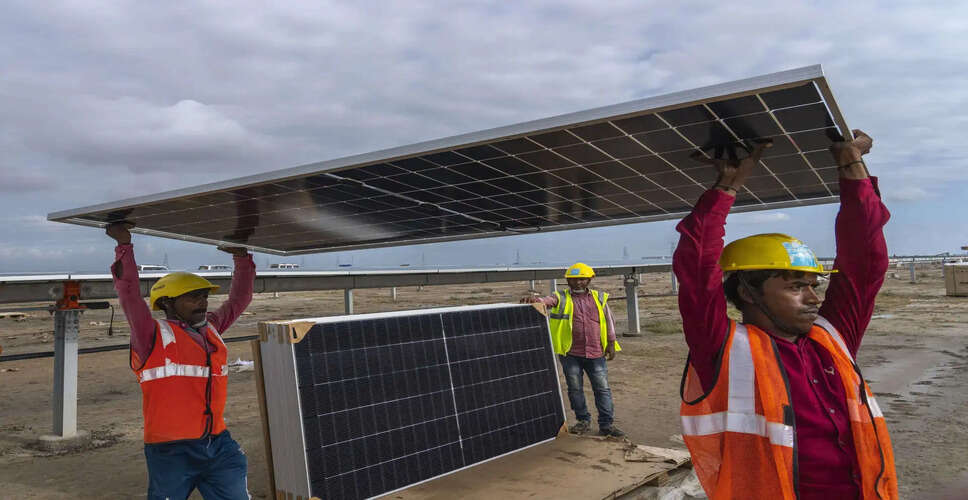

India's Solar Capacity Milestone
India has achieved a remarkable milestone in solar energy, surpassing the United States in annual solar capacity additions, thus becoming the second-largest market for solar growth globally, as stated by Pralhad Joshi, the Minister of New and Renewable Energy. According to data from Rubix Data Sciences, India's solar capacity is projected to reach between 280 and 300 GW by 2030, aligning with the national goal of achieving 500 GW of non-fossil fuel capacity. This ambitious target necessitates maintaining a consistent annual installation rate of 50 GW.
The International Renewable Energy Agency (IRENA) reported that India added 37 GW of solar capacity last year, compared to the US's 34 GW, while China led with an impressive addition of 315 GW. The report highlights that the financial year 2026 is pivotal for India's solar expansion, with cumulative installed solar capacity surpassing 150.26 GW as of March 31, 2026, marking a significant achievement.
During FY2026, India recorded its highest annual solar addition of 44.61 GW, exceeding the government's target of 34 GW and nearly doubling the previous record of 23.83 GW set in FY2024-25. Over the decade from FY2016 to FY2026, annual capacity additions surged from 3.13 GW to 44.61 GW, representing a more than fourteen-fold increase. The report indicates that distributed renewable energy from solar contributed 16.3 GW, accounting for 36% of total additions, while the Power Purchase Agreement (PPA) route and Commercial & Industrial (C&I) segment contributed 34% and 30%, respectively.
Rubix Data Sciences also noted a significant regional concentration in solar capacity, with seven states contributing approximately 85% of the total installed capacity. Rajasthan and Gujarat have consistently ranked as the top two states, while Maharashtra has climbed from 8th to 3rd place, and Karnataka has moved from 10th to 5th over the same period.
Rooftop Solar: A Sustainable Investment
Rooftop solar: A long-term cost reducing measure
Manufacturers of rooftop solar systems have observed a shift in homeowner perspectives, with many now viewing rooftop solar as both a sustainable investment and a long-term cost-saving measure. Pawan Kumar Garg, founder and joint MD of Fujiyama Power Systems, remarked, "India's achievement in surpassing the US in annual solar capacity additions sends a strong message that solar energy is becoming mainstream across the nation. Rooftop solar is crucial in this transition, enabling households and businesses to generate their own clean energy on demand."
Furthermore, the rapid increase in solar installations correlates with growing consumer confidence in renewable energy solutions. More homeowners are recognizing rooftop solar as a viable sustainability investment and a long-term cost-reduction strategy. Hanish Gupta, Founder & MD of Sunkind India Limited, emphasized, "India's solar momentum signifies a transformative shift in the country's development narrative. Supported by industry, investors, and government initiatives, solar energy is fostering human advancement and paving the way for a more self-sufficient and sustainable future. The next phase of leadership will be characterized by a comprehensive solution that integrates manufacturing, energy storage, and grid infrastructure into a cohesive, future-ready ecosystem."