
India Emerges as Asia's Third Most Powerful Nation: Insights from the 2026 Power Index
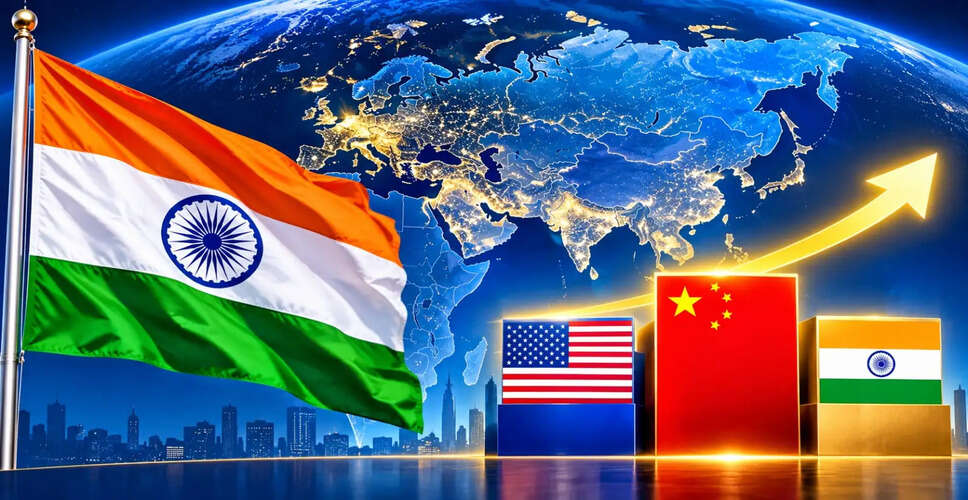

India's Rising Influence in Asia
New Delhi: According to the Lowy Institute's Asia Power Index 2026, India has maintained its status as the third most powerful nation in Asia, establishing itself as a significant force. Prime Minister Narendra Modi has been recognized as the second most effective leader in the region.
India's power score has seen an increase of 0.5 points, reaching 40.5, reflecting its growing influence across Asia. The gap in power scores between India and China has narrowed to its smallest margin since 2018.
The Index identifies the United States and China as the leading superpowers in Asia for 2026, with scores of 78.9 and 73.6, respectively, out of a possible 100.
This year, India has solidified its status as a 'major power', enhancing its influence through increased regional defense collaborations and the sale of BrahMos missiles to Southeast Asian nations, which have bolstered its defense networks. Additionally, stable trade and investment relationships have allowed India to maintain strong economic ties.
Despite a lower profile during the Gulf conflict, which affected perceptions of Modi's global leadership, the Index highlights his effectiveness as a regional leader, second only to Xi Jinping.
In terms of cultural influence, India recorded the highest gains (+2.3), while it experienced a decline in economic capability (-0.7). Improvements were also noted in defense networks (+2.1), future resources (+1.2), and military capability (+0.5). The scores for resilience, economic relationships, and diplomatic influence remained unchanged this year.
India's scores in economic capability and cultural influence are 26.4 and 43.8, respectively, with a diplomatic influence score of 70.3, according to the latest findings.
The Index indicates that despite challenges in economic capability and a focus on domestic issues, India has played a more influential role in Asia.
The 2026 Lowy Institute Asia Power Index evaluates 27 countries and territories based on 131 indicators to assess power dynamics in Asia.
The power score gap between the US and China has decreased, with only 5.3 points separating them, marking the closest margin since the Index's inception in 2018. The military capability gap is also at its lowest recorded level.
The US's diplomatic influence has dropped by 6 points to 76.7, marking its largest decline on record and the fourth consecutive year of decrease, influenced by factors such as the Iran conflict and trade tariffs.
Hunter Marston, Director of the Southeast Asia Program and Asia Power Index, noted that despite regional upheaval, the power balance remains distinctly bipolar, with the US and China still at the forefront.
In response to India's improved ranking, the ruling BJP criticized the Congress party, suggesting that this development serves as a wake-up call for them.
BJP spokesperson Pradeep Bhandari remarked that under Rahul Gandhi, Congress's future could be bleak, while asserting that India's trajectory under Modi is 'safe, secure, and prosperous'.
BJP Rajya Sabha MP Vinod Tawde also referenced the Index to counter opposition critiques of the Indian economy, emphasizing that the world acknowledges India's 'decade of rise'.
He stated, 'While the opposition portrays a narrative of decline abroad, the 2026 Lowy Institute Index positions India among Asia's top three powers, with PM Modi recognized as the region's second-most effective leader.'
Tawde concluded by urging those who criticize India internationally to consider the global assessment.