
India and UK to Launch Comprehensive Economic and Trade Agreement on July 15

Milestone Agreement Between India and the UK
India and the United Kingdom are preparing to implement their Comprehensive Economic and Trade Agreement (CETA) starting July 15, marking a significant advancement in their economic relationship. This agreement aims to enhance bilateral trade by reducing tariffs, expanding market access, and fostering collaboration in various sectors, including goods and services. Officials have indicated that final preparations are underway to ensure that customs systems and implementation processes are fully operational by the time the agreement takes effect. The goal is to enable businesses to immediately access preferential benefits on eligible shipments from day one.
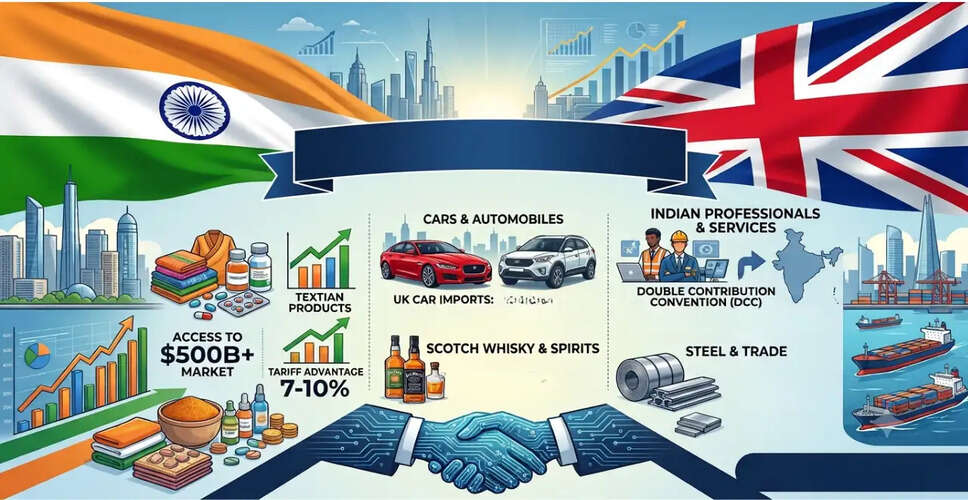
This trade agreement is projected to grant Indian exporters access to a market exceeding $500 billion. Officials anticipate that exporters will benefit from tariff reductions of approximately 7-10% compared to the existing trade framework, with duties on over 99% of tariff lines set to be eliminated gradually. Rather than a uniform tariff system, the agreement employs a mixed approach for certain sensitive sectors, allowing most product tariffs to be phased out while maintaining quota-based restrictions for select categories to protect domestic industries.
Key Beneficiaries: Cars, Whisky, and Steel
One of the most significant aspects of the agreement pertains to the automobile sector. India will progressively permit the import of up to 378,000 petrol and diesel passenger vehicles from the UK over a 15-year timeframe through a quota system. Import duties for specified categories will decrease from around 110% to 10% during the implementation phase, with different treatments based on engine size and vehicle type. Electric, hybrid, and hydrogen-powered vehicles will have limited access starting in the sixth year, although lower-priced electric vehicles will not benefit from tariff reductions, reflecting India's commitment to safeguarding its domestic electric vehicle industry.
The agreement also provides substantial benefits to the UK's spirits sector. Import duties on Scotch whisky and gin will be cut from 150% to 75% initially, with a further reduction to 40% by the tenth year. The International Spirits and Wines Association of India (ISWAI) has welcomed this development, noting that lower tariffs on Scotch whisky, including bulk imports for blending and bottling in India, will benefit local manufacturers and enhance consumer options. Currently, about 79% of Scotch imported into India is utilized by domestic companies for blending and bottling.
However, the Confederation of Indian Alcoholic Beverage Companies (CIABC) has urged state governments to eliminate concessions currently granted to bottled-in-origin imported brands, arguing that reduced import duties combined with state-level incentives could make imported products more affordable than domestically produced alcoholic beverages.
Additionally, the agreement addresses India's concerns regarding UK steel safeguard measures. Reports indicate that approximately 85% of India's steel exports will be exempt from restrictive measures, with concessions secured across 188 tariff lines. Ongoing discussions regarding unresolved issues are expected to continue at the World Trade Organisation (WTO).
Support for Indian Professionals and the Services Sector
The agreement introduces the Double Contribution Convention (DCC), which allows Indian professionals temporarily working in the UK to avoid paying social security contributions for up to five years. This provision is anticipated to lower costs for Indian IT and services firms, enhancing their competitiveness in the UK market. This arrangement aligns India with several other nations that already have similar social security agreements with the UK.
In addition to goods trade, the pact is expected to bolster exports in sectors such as information technology, financial services, education, and professional consulting. Investment relations are also likely to strengthen, with over 900 Indian companies currently operating in the UK.