
India and Netherlands Forge Strategic Partnership Amid Global Challenges

Strengthening Ties Through Strategic Agreements
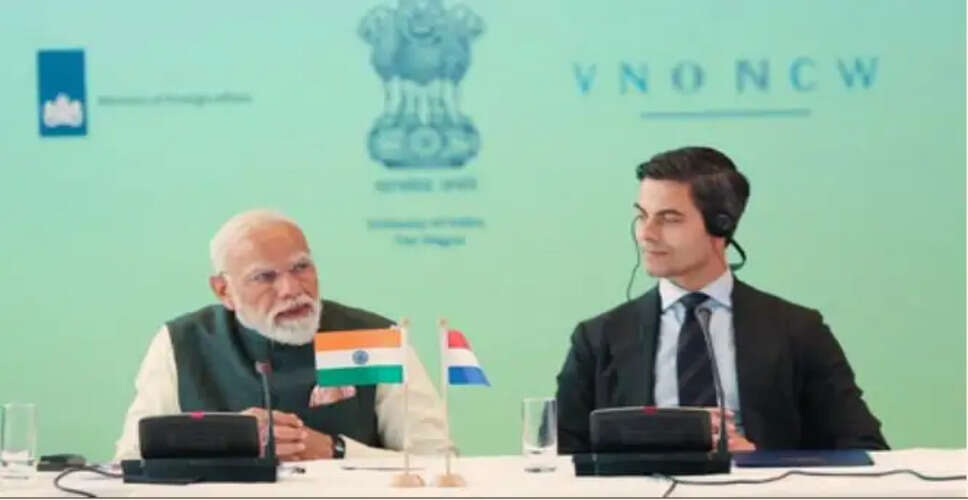
The Hague: In response to evolving global geopolitics, India and the Netherlands have upgraded their relationship to a strategic partnership, signing 17 agreements aimed at enhancing collaboration in defense, critical minerals, and other vital sectors during discussions between Prime Minister Narendra Modi and Dutch Prime Minister Rob Jetten.
During their meeting on Saturday evening, both leaders expressed significant concern regarding the situation in West Asia, particularly its serious repercussions for the region and the global community, especially concerning disruptions to energy supplies and trade routes.
Modi and Jetten emphasized the importance of maintaining freedom of navigation and the global flow of commerce through the Strait of Hormuz, opposing any restrictive measures, and reaffirmed their commitment to ongoing initiatives in this area, as stated in a joint declaration.
Approximately 20% of the world's energy supplies transit through this narrow passage, which has faced severe shipping disruptions since February 28, following a joint US-Israel attack on Iran that prompted retaliatory actions.
The leaders also addressed the ongoing conflict in Ukraine, marked by tensions with Russia and regional security issues.
They agreed to persist in supporting efforts aimed at achieving a comprehensive, just, and lasting peace in Ukraine through dialogue and diplomacy, adhering to the principles of the UN Charter and international law.
Modi arrived in The Hague on Friday for a two-day visit as part of a broader four-nation European tour aimed at strengthening bilateral relations across various key domains.
Following their discussions, India and the Netherlands introduced a 'strategic partnership roadmap' designed to enhance cooperation in trade, investment, defense, security, and emerging technologies, including semiconductors, space, artificial intelligence, and quantum computing.
Additionally, the two leaders launched an ambitious 'India-Netherlands roadmap for green hydrogen development.'
They also agreed to explore the establishment of a defense industrial roadmap to facilitate joint manufacturing of defense equipment, systems, components, and other essential capabilities through technology transfer and joint ventures.
The Netherlands ranks among India's largest trading partners in Europe, with bilateral trade reaching USD 27.8 billion in 2024-25. It is also India's fourth-largest source of foreign direct investment, totaling USD 55.6 billion.
With its world-class logistics network, the Netherlands serves as a strategic entry point to Europe for Indian exporters, primarily through the Port of Rotterdam.
During the talks, both sides committed to enhancing collaboration in science and innovation, sustainability, health, agriculture, water management, climate change, energy transition, maritime development, and cultural exchanges.
The agreements signed will bolster cooperation in semiconductors, critical minerals, health, water, renewable energy, agriculture, and culture, as per the Ministry of External Affairs.
A significant agreement focused on migration and mobility is expected to facilitate greater movement of Indians to the Netherlands for employment and educational opportunities.
In discussing geopolitical developments, the leaders advocated for a free, open, and peaceful Indo-Pacific region, grounded in respect for international law, sovereignty, territorial integrity, freedom of navigation, and the absence of coercion and conflict, as noted in the joint statement.
These remarks were made in light of rising global concerns regarding China's assertive actions in the region.
Recognizing the strategic significance of critical minerals for ongoing innovation, both prime ministers expressed a mutual interest in enhancing cooperation throughout the critical minerals value chain, including exploration and integration.
They welcomed an initiative to link the Dutch Semicon Competence Centre with the Indian Semiconductor Mission, which aims to bolster the semiconductor sector.
To enhance bilateral trade, Modi and Jetten highlighted the substantial potential for growth, particularly in light of opportunities arising from the recently signed India-EU Free Trade Agreement.
During the meeting, PM Modi expressed gratitude to Jetten for the Netherlands' continued support for India's bid for permanent membership in a reformed and expanded UN Security Council.
According to the joint statement, Jetten condemned the 'heinous and abhorrent' terrorist attack in Pahalgam in April 2025, which resulted in 26 fatalities, and reaffirmed his country's unwavering support for India in its fight against terrorism, including cross-border threats.
Both leaders unequivocally denounced terrorism in all its forms and called for a 'zero tolerance' approach to combat this menace, rejecting any double standards in counter-terrorism efforts.
'Significant progress has been made in India-Netherlands relations over the past decade,' Modi remarked during his televised opening statements with Jetten.
He emphasized that India regards the Netherlands as one of its most crucial partners, with deep-rooted historical and people-to-people connections.
'Democratic values, a market economy, and responsible behavior are integral to our shared approach. Our collaboration in water management, healthcare, and education has been improving the lives of our citizens,' he stated.
Modi also underscored India's economic growth, suggesting that the Netherlands' expertise should converge with India's 'speed and skill' across all sectors.
'We must elevate our cooperation in innovation, investment, sustainability, and defense to new heights. Under this shared vision, we are advancing India-Netherlands relations to the level of a strategic partnership,' Modi concluded.