
Impact of Middle East Tensions on India's Economic Growth Forecast
Economic Outlook Amid Middle East Conflicts
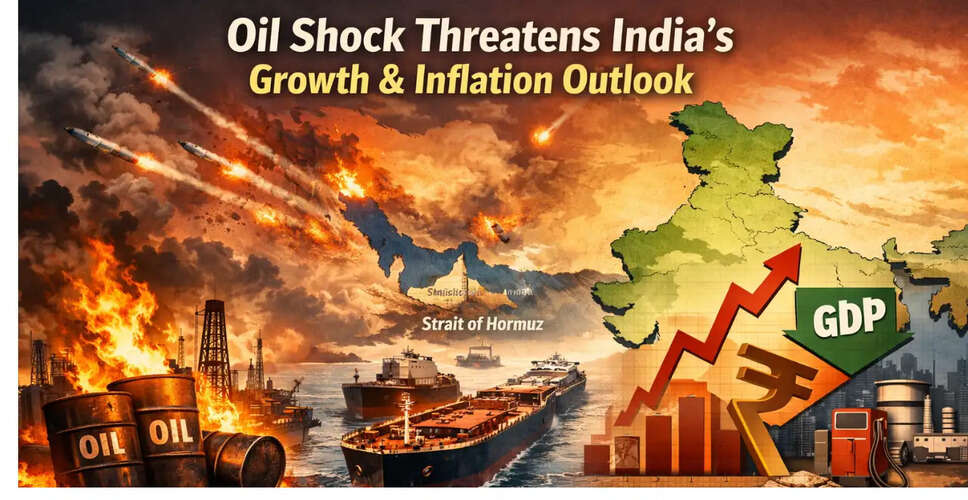
As tensions escalate in the Middle East, particularly due to the joint military actions by the US and Israel against Iran, economists are predicting a slowdown in India's economic growth, largely attributed to the country's dependence on imported oil. Analysts from various financial institutions, including Goldman Sachs, ICICI Bank, and IndusInd Bank, have expressed concerns regarding the increasing geopolitical risks.
In a recent report, ICICI Bank's economists highlighted that the ongoing conflict between Iran and Israel poses significant risks for India's economy in the Financial Year 2027 (FY27). They noted that if the situation continues, it could adversely affect exports, remittances, and oil prices. With crude oil prices averaging around USD 80 per barrel, the trade deficit could escalate to USD 383 billion, leading to a current account deficit of 1.4% of GDP. Furthermore, the prevailing global uncertainties are likely to dampen foreign portfolio investment, which could exert downward pressure on the Indian rupee, projected to fluctuate between 91.5 and 93.5 per US dollar in the near future.
Goldman Sachs has revised its GDP growth forecast for India for FY26 down to 6.5% from a previous estimate of 7%. Additionally, inflation is expected to rise to 4.2%, up from 3.9%. Meanwhile, Fitch Ratings anticipates India's economy will grow by 7.5% in FY26, but expects a slowdown to 6.7% in FY27, with inflation potentially reaching 4.5% by December due to increasing crude oil prices. The Australia and New Zealand (ANZ) Banking Group has also cautioned that India's significant reliance on imported energy will hinder growth, projecting an expansion of only 6.5% to 6.8% in the fiscal year starting in April, down from approximately 7%.
Government Data on Growth Projections
Prior to the escalation of the Middle East crisis, the Indian economy was showing promising signs. According to the initial official data released by the government, the economy grew by an impressive 7.8% in the October–December quarter of the current financial year. The government has also adjusted its GDP growth estimate for FY26 to 7.6%, an increase from the earlier forecast of 7.4%. The Economic Survey has revised the growth projection for FY27 to between 7% and 7.4%, compared to the previous estimate of 6.8% to 7.2%. As reported, India imports approximately 90% of its crude oil and nearly half of its liquefied petroleum gas (LPG). With the Strait of Hormuz effectively blocked by Iran, around half of India's crude and over three-fourths of its LPG imports have been disrupted, causing oil prices to surge beyond USD 100 per barrel.