Rupee Hits Record Low Against Dollar
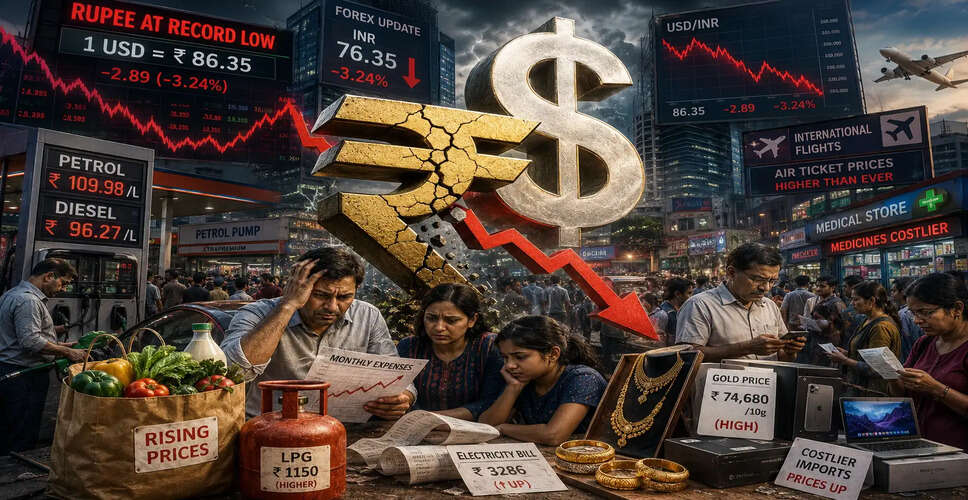
On Friday, the Indian Rupee fell below the 96 mark, reaching an unprecedented low of 96.14 against the US dollar during intraday trading. While fluctuations in the currency may seem like a macroeconomic issue, they significantly affect the everyday lives of citizens. The rupee's persistent decline is largely attributed to soaring crude oil prices amid the ongoing crisis in the Middle East, coupled with continuous outflows of foreign capital.
Effects of a Weakening Rupee on Daily Life
How falling Rupee affects your daily life
Increase in fuel prices: India relies heavily on imports for approximately 88% of its oil needs. Since crude oil transactions are conducted in US dollars, oil marketing companies face higher costs in rupee terms when the currency depreciates. This has led to a recent government decision to raise petrol and diesel prices by Rs 3 per litre.
Rise in prices of vegetables and food items: The increase in fuel prices also raises transportation costs, which is likely to make essential goods like vegetables and food items more expensive as they are transported across various locations.
Surge in gold prices: India is significantly dependent on imports to satisfy its gold demand. Payments for these imports are made in US dollars, which further weakens the rupee as foreign exchange reserves diminish. Policymakers are attempting to stabilize the currency by discouraging non-essential gold imports, resulting in elevated gold prices.
Inflation concerns: Economists often refer to a weak rupee as a source of “imported inflation,” as it increases the costs of imported goods and raw materials. Businesses facing higher costs typically pass these on to consumers, leading to increased prices for commodities, which can heighten inflation and diminish household purchasing power over time.
Reasons Behind the Decline of the Indian Rupee
Why Indian Rupee continues to decline?
The foreign exchange markets in India have seen increased volatility due to the ongoing crisis in West Asia. This situation is primarily driven by rising energy prices and fluctuating capital flows. The Reserve Bank of India (RBI) has taken proactive measures to mitigate speculative activities and maintain orderly exchange rate movements. Over the past year, the rupee has depreciated by 11%, with 4.7% of that decline occurring since the onset of the Iran conflict.
Dependence on imports: India’s reliance on imports for about 88% of its oil and 51% of its gas needs is significant. West Asia contributes to 15% of India’s goods exports, and nearly 38% of inward remittances originate from this region. CareEdge Ratings predicts that India’s Current Account Deficit (CAD) could widen to 2.1% of GDP by the Financial Year 2027, assuming global crude oil prices average around USD 90 per barrel. However, the CAD remains manageable compared to previous stress periods, supported by robust growth in service exports.
Foreign investor exit: The outflow of Foreign Portfolio Investors (FPIs) has intensified following the West Asia conflict, reaching USD 13.6 billion in March, marking the highest monthly outflow in six years. For FY26, FPI outflows totaled USD 16.6 billion, contrasting sharply with inflows of USD 2.7 billion in FY25. Additionally, Foreign Direct Investment (FDI) outflows have negatively impacted net FDI inflows, which were modest at USD 6.3 billion in the first 11 months of FY26, following a mere USD 1 billion in FY25.