
Impact of AI Growth on India's Water Resources: A New Report
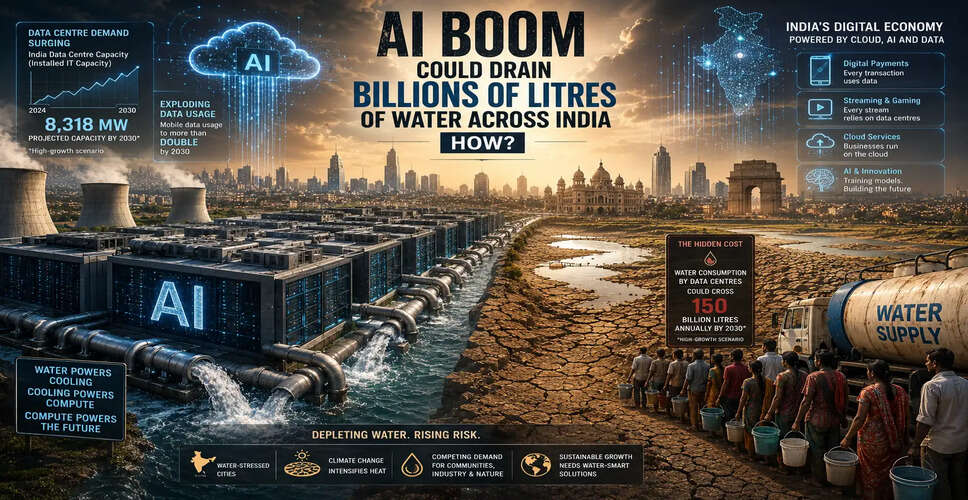

AI and Data Centres: A Growing Concern for Water Resources
A recent report highlights that India's burgeoning Artificial Intelligence (AI) and data centre sectors may soon exert significant pressure on the nation's water supply. The study, released by NFPRC-CAIG and titled "Beyond Infrastructure: India’s Data Centre Pathway to Digital Sovereignty", indicates that the increasing demand for AI processing, cloud services, video streaming, and other digital offerings is likely to lead to a substantial rise in water usage by data centres in the coming years. These facilities are essential for powering AI applications, digital transactions, OTT platforms, cloud storage, and various enterprise solutions, all of which require extensive cooling systems to manage server temperatures, often consuming vast amounts of water.
The report forecasts that India's data centre capacity could escalate from approximately 1,352 MW in 2024 to as much as 8,318 MW by 2030 in a high-growth scenario. This expansion is expected to coincide with a dramatic increase in annual water consumption, heavily influenced by the cooling technologies employed by data centre operators. This issue is particularly pressing as key data centre locations such as Delhi-NCR, Chennai, Bengaluru, Hyderabad, and Pune are already facing challenges related to water scarcity and increasing urban demand.
Water: A Vital Resource for Data Centres
Water has become the second most crucial resource for data centres, following electricity. The swift growth of cloud services, colocation facilities, and AI computing clusters has heightened the dependence on cooling systems, many of which require significant water supplies. The report notes that globally, data centres consume millions of cubic meters of water each year to ensure thermal stability for sensitive IT equipment. In India, where many digital hubs are situated in areas already experiencing water stress and climate challenges, effective water management is essential for future infrastructure planning.
To aid in informed decision-making, the report introduces a city-level Water Usage Effectiveness (WUE) framework that connects climate science, cooling technology, and data centre design through a structured approach: City, Climate Zone, Temperature, Cooling Technology, and WUE.
Projected Surge in Water Consumption
The analysis predicts that India's data centre capacity could grow significantly, with annual water consumption potentially increasing dramatically based on the cooling methods chosen by operators. The report provides calculations for water usage in data centre operations, stating that Water Usage Effectiveness (WUE) = 2.1 L/kWh for conventional direct evaporative or adiabatic cooling systems typically used in hot-dry climates, while WUE = 2.8 L/kWh applies to water-intensive cooling tower systems.
For each year, capacity trajectory, and WUE scenario, the annual water consumption is calculated as follows: Annual Water Use = Installed IT Capacity (MW) × 1000 × 8760 × 0.8 × WUE. The results are compiled and expressed in billion liters per year, allowing for direct comparisons with municipal, industrial, and basin-level water demand metrics. This analysis focuses solely on the direct operational water use related to data centre cooling, excluding upstream water consumption linked to electricity generation or infrastructure development. Although this offers a limited lifecycle perspective, it highlights the water demand component most pertinent to site selection, regulatory approvals, and assessments of local water stress.