
How Odisha's Green Economy Could Create One Million Jobs in the Next Decade

Bhubaneswar's Green Job Potential
Bhubaneswar: The growth of Odisha's green economy is projected to create nearly one million jobs over the next ten years. However, a skilled workforce is essential to realize this potential, as highlighted in a recent report by the International Forum for Environment, Sustainability and Technology (iFOREST).
The report, titled “Workforce for Odisha’s Green Economy: Potential for Jobs, Skills and Entrepreneurship,” was unveiled at the World Skill Center in Bhubaneswar on Thursday. The event saw participation from state government officials, industry representatives, training institutions, and civil society organizations, who engaged in discussions regarding the report's insights. It advocates for the establishment of a dedicated 'Odisha green jobs and skilling mission' to synchronize education and skill development with the needs of emerging green industries, thereby broadening employment prospects in new sectors.
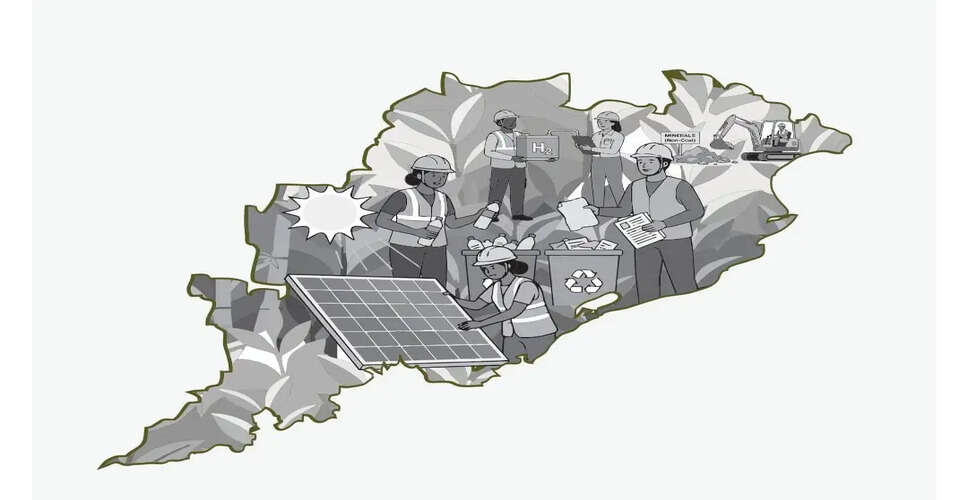
According to the findings, Odisha has two primary opportunities in the green transition. The first involves generating new jobs in rapidly growing green sectors, while the second focuses on enhancing the skills of the existing industrial workforce to facilitate their transition into new green roles. Waste management is identified as another significant area for potential job creation. Collectively, these sectors could contribute to the creation of nearly one million jobs in Odisha's green economy over the next decade.
Moreover, there is a substantial opportunity to transition workers from traditional energy and industrial sectors into new green roles. The report estimates that 89% of jobs in coal mining could be shifted to the state's burgeoning metal and critical-mineral mining sectors. Similarly, around 75% of jobs in thermal power could be relevant to renewable energy and green hydrogen initiatives. The report suggests that many of these transitions could be achieved through short-term, targeted training programs rather than extensive retraining.
“Green job opportunities extend beyond just renewable energy and industries; they encompass a variety of environmentally friendly and sustainable professions. With this in mind, our department is committed to supporting Odisha’s green skilling initiatives,” stated Sukanta Kumar Pradhan, Additional Secretary of the Skill Development and Technical Education Department. The report also points out a notable skills gap, despite Odisha's relatively high workforce participation rate.
In 2025, the state's labor force participation rate was recorded at 67.9%, with an unemployment rate of 3.3%, both figures indicating a favorable position compared to national averages. However, only 3.3% of the workforce possesses technical education, and vocational training has reached merely around 3% of the population.