
Government Urged to Strengthen E-Commerce Food Labeling Regulations

Call for Enhanced Regulations on Packaged Food
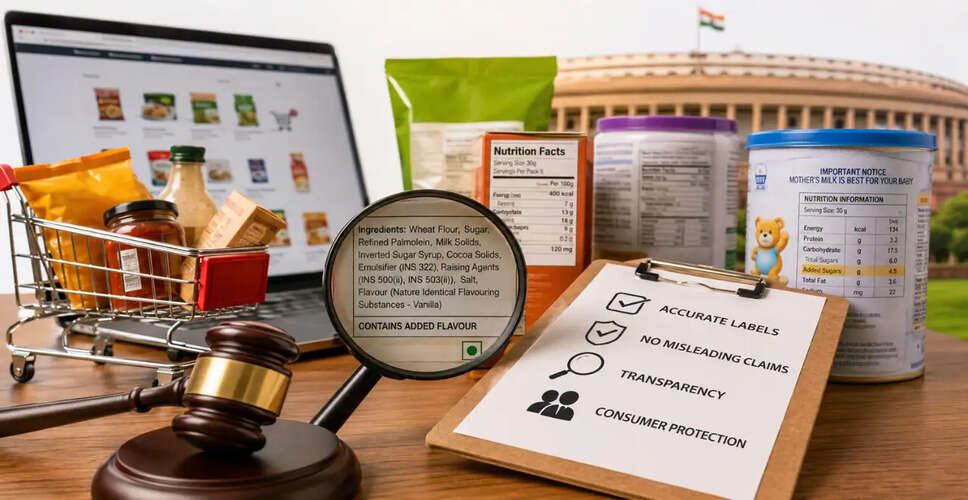
A Parliamentary Standing Committee has recommended that the government implement stricter regulations for packaged food sold through e-commerce platforms. The committee highlighted that consumers often encounter misleading labels and inaccurate claims when purchasing food online. This recommendation was part of the committee's Fifteenth Report titled "Regulation of Packaged Commodities with Specific Reference to Sugar Content in Baby Products and Other Food Products," which was presented in the Lok Sabha. The committee emphasized that as food retail shifts rapidly to online platforms, existing consumer protection regulations have not adapted accordingly.
This issue aligns with the ongoing campaign, E-Comms Hiding Health Info, which has been documenting the lack of transparency in quick commerce apps that sell packaged products without displaying essential information.
Concerns Raised About Online Food Sales
The committee noted that the rapid expansion of e-commerce has led to increased online sales of packaged food, complicating the verification of label accuracy and truthfulness of claims. To address this, the committee has urged the Department of Consumer Affairs to collaborate with the Food Safety and Standards Authority of India (FSSAI), State Food Safety Authorities, and the Central Consumer Protection Authority (CCPA). Together, these organizations should establish a unified monitoring system to identify and rectify mislabeling and misleading claims in online listings.
Findings from the Campaign
Through the E-Comms Hiding Health Info campaign, accountability has been sought from quick commerce platforms such as Zepto, Swiggy Instamart, Blinkit, and BigBasket for failing to provide basic product information that consumers would typically find on physical store shelves. Critical details like manufacturing and expiry dates are often omitted, leaving customers unaware of what they are purchasing until after delivery. The committee's recommendations underscore that this is not merely an issue of isolated bad listings, but rather a systemic lack of oversight.
Push for Clearer Sugar Labeling
In addition to online sales, the committee advocated for clearer sugar content labeling to aid consumer understanding. They supported the introduction of a mandatory sugar classification system under the Front-of-Pack Nutrition Labelling framework. The committee pointed out that simply stating sugar content in grams does not effectively inform consumers about whether the amount is excessive or minimal. Any classification should be based on scientific standards aligned with the World Health Organization (WHO) and the Indian Council of Medical Research (ICMR).
Furthermore, the committee insisted that these sugar labeling regulations apply universally across all packaged food categories, with no exceptions, and recommended a review of permissible sugar limits in products designed for infants and young children every two to three years.
Stricter Regulations for Infant and Children's Food
For products targeting infants and children, the committee suggested a front-of-pack declaration indicating the amount of added sugar per serving and its contribution to the recommended daily energy intake for that age group. They also called for regular scientific reviews of permissible sugar limits in infant formula and complementary foods, with findings made publicly available.
Delays in Nutrition Labelling Regulations
The committee expressed concern over the prolonged delay in finalizing the Front-of-Pack Nutrition Labelling regulations, which were initially drafted in September 2022. They urged the FSSAI to expedite the process and formally implement the rules within a specified timeframe. Additional recommendations included:
- Prominent, color-coded warning labels on high-sugar products
- Graded penalties for repeat offenders making false sugar claims
- Fixed deadlines for correcting or withdrawing non-compliant advertisements
- Routine public disclosure of enforcement actions taken
The E-Comms Hiding Health Info campaign continues to monitor compliance issues on quick commerce platforms.