
Escalating Tensions: Pakistan and Afghanistan on the Brink of War
Conflict Erupts Along the Durand Line
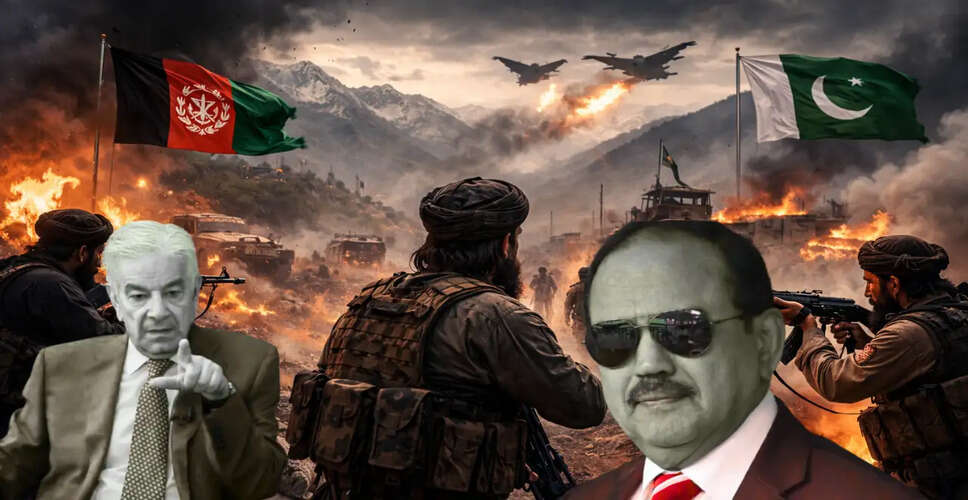
On the night of February 26, 2026, the Durand Line transformed into a conflict zone once more. The Afghan military initiated fire on Pakistani border posts near Chaman and Torkham, leading to a rapid response from Pakistan. The operation, dubbed 'Righteous Fury' or Operation Ghazab Lil Haq, involved airstrikes and artillery targeting Taliban positions in Kabul and other provinces like Kandahar, Paktia, and Nangarhar. Pakistani officials reported the deaths of at least 133 Taliban fighters, with over 200 injured, while the Afghan government claimed eight of its soldiers were killed, alongside two Pakistani troops in the initial skirmish. By Friday morning, the situation remained tense, with tanks deployed along the border and both nations exchanging accusations. Pakistan's Defence Minister Khawaja Asif characterized the situation as 'open war,' while Taliban representatives warned of severe repercussions for Pakistan. Social media footage depicted protests in Kabul, where demonstrators burned Pakistani flags, while voices in Pakistan questioned the ongoing conflict between two Muslim nations.
The immediate trigger for this escalation appears to be a Pakistani airstrike on February 21, targeting suspected militant hideouts in Nangarhar, Paktika, and Khost provinces. Islamabad alleged these camps were linked to the Tehrik-i-Taliban Pakistan (TTP), responsible for numerous attacks in Pakistan recently. Kabul, however, denied harboring anti-Pakistan militants. The Afghan assault on border posts was seen as retaliation, prompting Pakistan's significant counterattack.
Economic Strain: Can Pakistan Sustain a War?
The Money Side – Pakistan Is Already Walking a Tightrope
Pakistan's economy has faced significant challenges for years. After narrowly avoiding default in 2023, it managed to stabilize with assistance from international partners. However, the economic indicators remain precarious:
- Nominal GDP is approximately $410 billion.
- Growth is sluggish, projected at 3.75–4.75 percent for the current fiscal year.
- Inflation hovers around 7.5 percent.
- Foreign exchange reserves are about $20 billion, sufficient for only two and a half months of imports.
- Public debt ranges from 68 to 70.7 percent of GDP, with external debt exceeding $131 billion.
- Defense spending consumes between 1.97 and 2.7 percent of GDP, making it the second-largest budget item after interest payments on debt.
The recent military operations, including airstrikes and troop movements, incur substantial costs. Each day of conflict escalates expenses related to fuel, ammunition, and logistics. Border trade has already suffered; since restrictions were imposed in October 2025, Pakistan has lost an estimated $375 million in exports to Afghanistan and $225 million in re-exports to Central Asia. A full-scale war would devastate this trade, leading to an influx of refugees and straining Pakistan's resources further. If the conflict persists, the stability of the IMF program could be jeopardized, potentially leading to a withdrawal of foreign support and a depreciation of the rupee, resulting in soaring domestic prices for essential goods.
Military Dynamics: Firepower vs. Strategy
The Battlefield Reality – Superior Firepower Does Not Guarantee Victory
On paper, Pakistan's military capabilities are formidable, ranking 14th globally with 660,000 active personnel, 465 combat aircraft, and over 2,600 tanks. In contrast, Afghanistan ranks 121st, with a significantly smaller force and limited air capabilities. However, historical precedents caution against overconfidence. The Soviet Union's invasion and the prolonged U.S. presence in Afghanistan ended in failure despite overwhelming military strength. The challenging terrain, porous borders, and tribal dynamics complicate any military engagement. If Pakistan attempts to maintain a presence within Afghanistan, it would require a substantial and costly occupation force, which it cannot afford. Conversely, remaining on its side of the border allows for punitive actions but not a decisive victory against the Taliban, potentially exacerbating the insurgency.
The India Angle: Accusations and Implications
The Alleged 'India Factor' in Pakistan's Border War with Afghanistan
Pakistan's leadership has accused India of exacerbating the conflict with Afghanistan, claiming that the Taliban has become a proxy for Indian interests. Defence Minister Khawaja Asif publicly stated that Afghanistan has effectively become an 'Indian colony.' He alleged that India supports the Taliban, facilitating the activities of groups like the TTP, which threaten Pakistan's security. This narrative has been echoed in Pakistani media, suggesting that India's involvement complicates Pakistan's military efforts on two fronts.
Indian officials have dismissed these claims as unfounded propaganda aimed at diverting attention from Pakistan's internal security issues. Despite the accusations, Pakistan has yet to provide concrete evidence to substantiate its claims. The historical pattern of mutual blame between India and Pakistan regarding Afghanistan has persisted since the 1990s, intensifying after the U.S. invasion in 2001.
Looking Ahead: The Path to Peace
What Comes Next?
Neither Pakistan nor Afghanistan stands to gain from an all-out war. Pakistan would incur significant financial and human costs for an objective that has proven elusive for larger powers. Afghanistan, while devastated, would likely endure as it has in the past. The UN Secretary-General has called for dialogue and restraint, highlighting the shared challenges both nations face, including poverty and terrorism. Recent diplomatic efforts indicate that communication remains possible. While the recent military actions may have felt justified to some, a prolonged conflict would likely lead to disaster for both countries. The more prudent approach would be to cease hostilities and seek a peaceful coexistence, as the alternative could result in a slow and costly downfall for both nations.