
China Responds to Pentagon's Claims: Aiming to Disrupt US-India Relations?
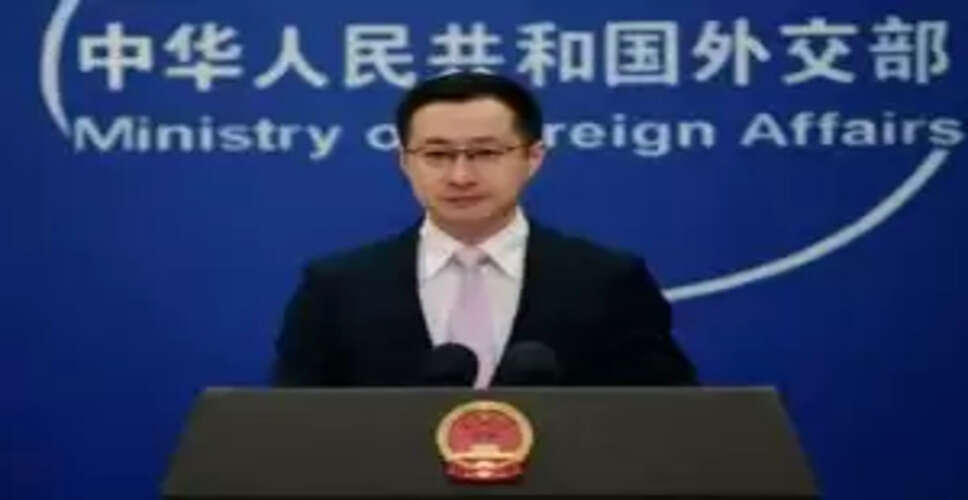
China's Strong Rebuttal to US Defense Report
Beijing: On Thursday, China criticized a Pentagon report that accused it of exploiting reduced tensions with India to weaken US-India relations while strengthening military ties with Pakistan, labeling the claims as an attempt to create discord through misinformation.
Lin Jian, a spokesperson for the Foreign Ministry, stated during a media briefing that the Pentagon's assertions misrepresent China's defense strategy, aiming to create rifts between China and other nations while providing a rationale for the US to uphold its military dominance.
Lin firmly rejected the report's conclusions.
In a separate statement, Zhang Xiaogang, a spokesperson for the Chinese Defense Ministry, condemned the Pentagon's findings, which also noted the growing collaboration between China and Pakistan in defense and space, including plans for a military base.
Zhang remarked that the US consistently publishes such reports, which interfere grossly in China's domestic matters.
He criticized the report for misinterpreting China's defense policies and making baseless assumptions about its military advancements, accusing it of tarnishing the legitimate actions of the Chinese military without addressing the specific allegations regarding China's defense cooperation with Pakistan.
Zhang described the report as rife with misunderstandings and geopolitical biases, exaggerating the so-called 'Chinese military threat' to mislead the global audience.
He expressed strong dissatisfaction and opposition to the report, urging the US to cease fabricating false narratives that provoke conflict and hostility.
In response to the Pentagon's remarks on India-China relations, Lin emphasized that Beijing approaches its relationship with New Delhi from a strategic and long-term viewpoint.
He stated, 'We are prepared to enhance communication, build mutual trust, foster cooperation, and effectively manage differences with India to promote a healthy and stable bilateral relationship.'
Regarding the US report's references to the Line of Actual Control, Lin asserted that the border issue is a bilateral matter between China and India, noting that the current border situation is generally stable with effective communication channels.
He reiterated China's opposition to the unfounded and irresponsible comments from the relevant country.
In its annual report to Congress titled 'Military and Security Developments Involving the People's Republic of China 2025,' the US Department of War suggested that China might seek to benefit from the easing tensions along the Line of Actual Control with India to stabilize bilateral relations and hinder the strengthening of US-India ties.
The report mentioned a meeting between Chinese President Xi Jinping and Indian Prime Minister Narendra Modi during the BRICS Summit in October 2024.
Prior to their meeting, an agreement was reached to disengage from the remaining standoff sites along the Line of Actual Control.
The Xi-Modi meeting initiated a series of monthly high-level discussions between the two nations, focusing on border management and future steps for their relationship, including direct flights, visa facilitation, and exchanges of academics and journalists.
The report also noted that China's leadership has expanded the term 'core interest' to encompass Taiwan and its sovereignty claims amid territorial disputes in the South China Sea, the Senkaku Islands, and Arunachal Pradesh.
Additionally, it highlighted the defense and space cooperation between China and Pakistan, indicating that Beijing is likely considering establishing a military base in Pakistan.
The report stated that China is actively planning for additional military facilities, with Pakistan being one of the countries under consideration for a base.