
Call for Fair Revenue Sharing in India's Digital Content Landscape
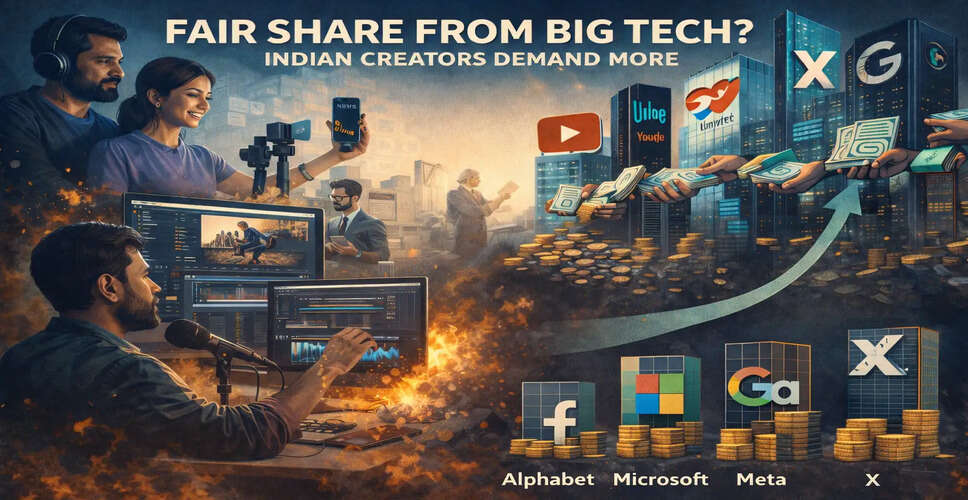
Union IT Minister Advocates for Fair Revenue Distribution
New Delhi: During a recent event hosted by the Digital News Publishers Association, Union IT Minister Ashwini Vaishnaw made a significant statement that resonated with many in the social media and streaming sectors: platforms must fairly share revenue with content creators, including journalists, media organizations, influencers, educators, and researchers. His remarks were met with applause, yet the platforms remained silent. This raises a crucial question for India's creator economy: What constitutes a fair share? While the discussion on this topic isn't new, Vaishnaw's comments have added a sense of urgency. He cautioned that if platforms do not adopt a voluntary revenue-sharing model, legal measures could be implemented, as seen in several other countries. India requires not just a principle but a specific figure, and evidence suggests that a minimum of 70% is warranted.
Examining the current state of revenue sharing reveals significant disparities, with some arrangements appearing quite exploitative. For instance, YouTube's blog indicates a revenue split of 55% for long-form videos and 45% for Shorts. However, this figure deserves closer examination. Alphabet's Q4 2025 earnings report shows that YouTube's total ad and subscription revenue surpassed $60 billion for the year, yet the company has not disclosed how much of that actually reaches creators. At its 2025 ‘Made on YouTube’ event, YouTube announced cumulative payouts to creators, artists, and media companies totaling $100 billion since 2021, but without any detailed breakdown of how this amount is distributed or verified. In the absence of transparent and audited earnings data for creators, the 55% split remains a theoretical figure rather than a reality for the millions of creators fueling a $60 billion industry.
Instagram's situation is even more challenging to justify. Meta previously offered creators a 55% share through in-stream video ads but abandoned this model in February 2022 when it shifted focus to Reels, as reported by Digiday. Since then, the platform has not provided any substantial direct ad revenue share to creators for its most popular format. Creators producing Reels do not receive any direct compensation from the platform's advertising revenue. According to a report from The Wrap, Instagram Reels is projected to generate over $50 billion in annual ad revenue, primarily based on content created, uploaded, and promoted by users, often without any financial return.
On the other hand, X, formerly known as Twitter, compensates creators approximately $8.50 for every million verified impressions through its Ads Revenue Sharing program, according to an Epidemic Sound report. This amount is so minimal that it hardly qualifies as recognition, let alone fair compensation. X's Help Centre clarifies that only impressions from verified Premium users contribute to payouts, meaning that the majority of a creator's audience—those who do not subscribe—generate no revenue for the content they engage with.
Why 70% Is the Right Benchmark
The argument for establishing a 70% revenue share across social media platforms, AI companies, YouTube, and Google is grounded in economic rationale and fairness. While platforms provide essential infrastructure, algorithms, and distribution, the journalism, analysis, breaking news, video essays, and tutorials are what truly drive advertiser interest, user retention, and overall valuation. Without creators, these platforms would merely be empty vessels adorned with appealing designs.
Between 2020 and 2023, YouTube reportedly paid over $70 billion to creators worldwide, according to a Grey report. Additionally, many Large Language Models (LLMs) and recommendation systems rely on media reports, academic writings, creative works, and original analyses—often scraped, ingested, and monetized without consent, credit, or any dialogue with the original creators. If this content generates commercial value, a 70% share returning to its creators is not an act of generosity; it is a necessary correction. Vaishnaw emphasized this point, stating, "Society has developed on the foundation of intellectual property and creative effort. If this system is compromised, societal growth itself will be hindered."