
Art Exhibition Showcases Ajanta-Ellora Cave Paintings in Ahmedabad
Celebrating Artistic Heritage
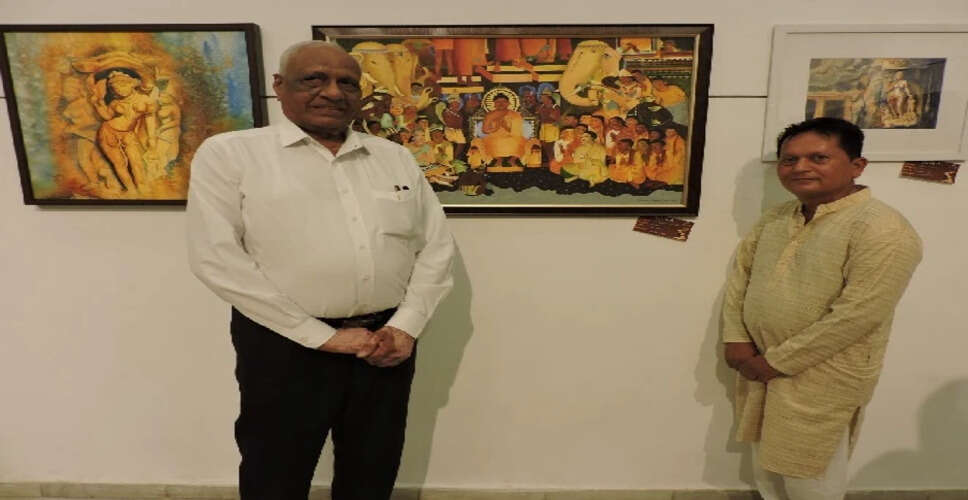
The Circle of Art Foundation, an organization dedicated to promoting artists, hosted an exhibition titled "Cave Paintings" from June 6 to 8, 2025, at the Hathi Singh Visual Art Center in Ahmedabad. This event was presided over by the prominent industrialist and philanthropist, Mr. Maganbhai Patel, who also served as the chief guest and main donor. Special guests included Mr. Surendrabhai Patel, founder of "Vishala," and renowned interior architect Mr. Niravbhai Shah. The exhibition was organized by Mr. Ajay Chauhan, Mr. Preeti Kaneria, and Mr. Rajesh Baraiya, who consistently arrange such events with financial support from Mr. Patel, aiding artists in their endeavors. Last year, under Mr. Patel's leadership, the foundation showcased "Pichwai," an art form depicting the childhood pastimes of Lord Krishna on fabric, where he also contributed financially to encourage artists.
Significance of Ajanta-Ellora Caves
During the event, Mr. Maganbhai Patel highlighted that the Ajanta and Ellora caves in Aurangabad, India, are recognized as UNESCO World Heritage Sites. These caves are among the largest rock-cut cave complexes globally, featuring Hindu, Buddhist, and Jain caves. They exemplify Indian rock-cut architecture, with many caves lacking ceilings, thus not being true caves. The Ajanta-Ellora caves are celebrated for their 30 rock-cut Buddhist cave monuments, regarded as masterpieces of Buddhist religious art, with sculptures considered some of the finest examples of ancient Indian artistry. The Ajanta caves showcase ancient monasteries carved into a 75-meter (246 feet) high rock wall, depicting stories of the Buddha's previous lives and Buddhist deities.
Historical Context and Cultural Legacy
The Ajanta caves are mentioned in the accounts of several Chinese Buddhist travelers from the medieval period. Located in the U-shaped valley of the Waghur River on the Deccan Plateau, the caves are accompanied by numerous waterfalls, audible during the river's swift flow. Mr. Patel further noted that another significant piece of Buddhist heritage can be found in Gujarat's Junagadh, specifically on the route to Girnar Mountain, where around 14 Ashoka inscriptions are located. These inscriptions, written in Brahmi script in the Pali language, address themes of non-violence and purity of thought, reflecting Emperor Ashoka's commitment to Buddhism and his efforts to promote ethical governance across his empire.
Ashoka's Edicts and Their Impact
Concluding his speech, Mr. Patel remarked that Ashoka's edicts comprise over thirty inscriptions found on pillars, rocks, and cave walls, spanning modern-day India, Bangladesh, Nepal, Afghanistan, and Pakistan. These inscriptions are among the earliest written records in India, carved into stone. Ashoka referred to his edicts as "Dhamma Lipi" ("Essays on Dharma"), detailing his religious policies. During this period, the reach of his teachings extended to the Mediterranean region, influencing Greek thinkers. While the edicts mention Ashoka's conversion to Buddhism, they primarily promote universal and non-sectarian values. The core principles of Dhamma, as defined by Ashoka, include non-violence, respect for parents, reverence for religious teachers, and humane treatment of servants, serving as a unifying force for the empire.
Artistic Display and Community Engagement
The exhibition featured over 70 cave paintings created by 50 artists, viewed by attendees under candlelight, creating an immersive experience reminiscent of exploring the caves. At the conclusion of the event, artists took photographs with dignitaries alongside their artwork.