
Delhi High Court Allows Vinesh Phogat to Compete in Asian Games Selection Trials

Court Ruling on Vinesh Phogat's Eligibility
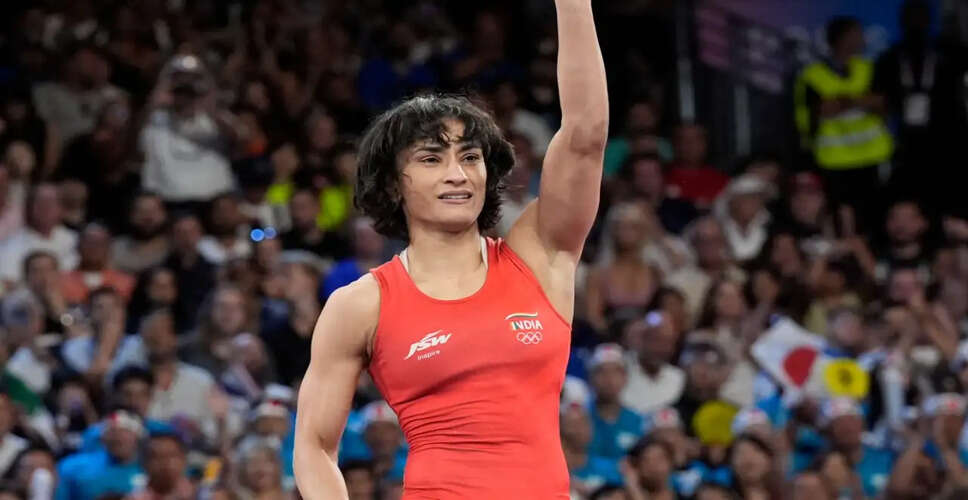
Babita Phogat, a prominent BJP figure, expressed her approval of the Delhi High Court's ruling permitting Indian wrestler Vinesh Phogat to take part in the upcoming Asian Games 2026 selection trials set for May 30 and 31. This decision follows the Wrestling Federation of India (WFI) declaring Vinesh ineligible for domestic competitions. Babita, a former wrestler, stated that the court's ruling was justified and should be embraced. She remarked, "I accept the court's decision, and it is the right one. Regardless of the circumstances, the court has made its ruling. Nothing supersedes the court, so we must appreciate and thank it for its decision."
On Sunday, the Delhi High Court not only allowed Vinesh to participate in the selection trials but also mandated that the trials be recorded on video and supervised by independent observers from the Sports Authority of India (SAI) and the Indian Olympic Association (IOA).
The WFI had issued a show-cause notice to Phogat on May 9, citing various concerns, including her failure to meet the weight requirements during the 2024 Summer Olympics, alleged anti-doping whereabouts failures, and her competing in two weight categories during Olympic qualifier trials.
A Division Bench, led by Chief Justice Devendra Kumar Upadhyaya and Justice Tejas Karia, issued these directives while reviewing Phogat's appeal against a prior interim order from a single judge that denied her interim relief in a writ petition challenging the WFI's selection policy and the show-cause notice.
The Court ruled that Phogat must be allowed to participate in the selection trials, with the entire process being video-recorded by the WFI, and two independent observers appointed by SAI and IOA overseeing the trials and reporting back to the Single Judge.
In granting interim relief, the Bench made important comments regarding the maternity rights of female athletes. The Court emphasized that motherhood should not be seen as a professional hindrance or a reason for negative treatment. It stated that any legal or regulatory framework that disadvantages a female athlete due to pregnancy or post-partum recovery would violate the principles of equality and dignity as outlined in Articles 14 and 21 of the Constitution.
The Bench acknowledged the unique physical challenges female athletes face during pregnancy and the post-partum period, which are often overlooked in sports regulations. The Court asserted that motherhood deserves recognition and institutional sensitivity, and should not serve as a basis for exclusion or marginalization.
Phogat had contested the WFI's Asian Games Selection Policy from February 25, 2026, and a subsequent circular from May 6, 2026, which limited eligibility for the selection trials to medalists from specific domestic tournaments held in 2025 and 2026.
According to the ruling, Phogat had notified the International Testing Agency (ITA) in December 2024 about her maternity leave and her intention to return to competition later. After giving birth to her first child in July 2025, she resumed training. The ITA confirmed her eligibility to compete starting January 1, 2026.
The Court noted that due to her maternity-related absence, Phogat was unable to compete in the championships that were prerequisites for eligibility under the WFI policy, leading to her exclusion from the selection trials. The Bench found the policy and circular to be arbitrary and discriminatory, as they limited participation to medal winners from certain events, thereby excluding athletes like Phogat.
Additionally, the Court criticized the WFI's comments in the show-cause notice regarding the Paris Olympics 2024 weigh-in incident, labeling them as "deplorable" and suggesting they appeared vindictive and premeditated, especially since the Court of Arbitration for Sport had already determined that Phogat had committed no wrongdoing.
However, the Division Bench clarified that it had not made any final judgment on the case's merits, and the pending writ petition before the Single Judge would be resolved based on its own merits.