
The Historic Battle of Budgam: A Turning Point in Indian Military History
The Budgam battle of 1947 marked a significant turning point in Indian military history, showcasing the crucial role of the Indian Air Force. Amidst chaos in Kashmir, the IAF's Spitfire, Harvard, and Tempest aircraft played a decisive role in defending the Srinagar airfield and supporting ground troops. This engagement not only highlighted the bravery of Indian soldiers but also established air power as a strategic force in warfare. As India faces modern challenges, the lessons from Budgam remain relevant, emphasizing the importance of morale, coordination, and proactive defense strategies.
| Nov 4, 2025, 18:11 IST
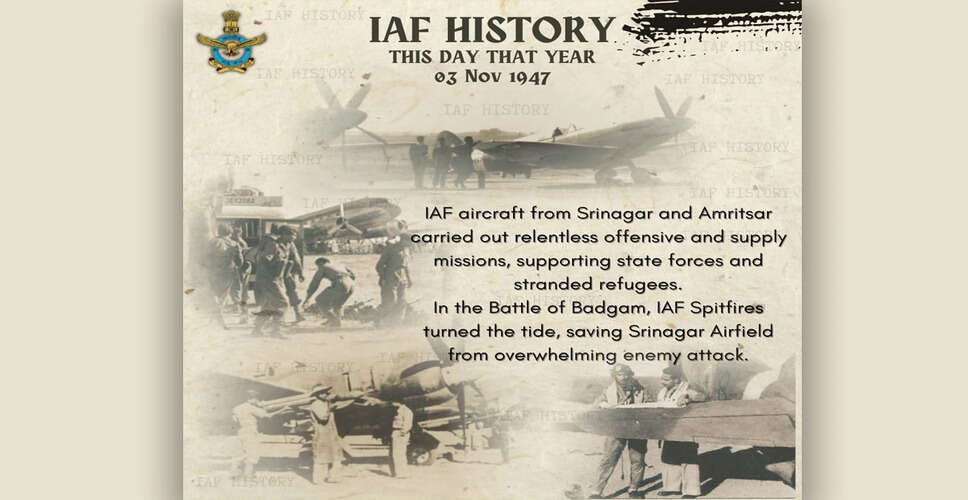
A Glimpse into Indian Air Force's Role in the 1947 Budgam Battle
The Indian Air Force has shared a significant excerpt from the annals of Indian military history, highlighting the pivotal role played by Spitfire, Harvard, and Tempest fighter aircraft during the historic Budgam battle in 1947. This battle was a crucial engagement in the First India-Pakistan War, taking place in the strategically vital Budgam district of Jammu and Kashmir.
On November 3, 1947, amidst chaos in Kashmir, the Indian Air Force took to the skies to defend the valley. From Srinagar and Amritsar, the Spitfire, Harvard, and Tempest aircraft launched a vigorous assault, destroying enemy positions and delivering supplies from the air. A poster accompanying the post emphasized the relentless offensive and supply missions carried out by the Indian Air Force, which aided both troops and stranded refugees. Notably, the Spitfire aircraft played a crucial role in safeguarding the Srinagar airfield from intense enemy attacks, altering the course of the situation. The post elaborated on the Indian Army's position and its response during this critical time.
Read More: Media House: Pakistan Shaken as India's Trishul Roars Near the Border
The post further stated, “The stance of Indian soldiers in Budgam ensured the security of the Srinagar airfield, which was vital for Indian Army operations. This battle symbolizes courage, sacrifice, and tenacity, marking a significant turning point in the conflict.” This front was particularly crucial as maintaining the capital Srinagar and its airfield was essential for guiding India's efforts at that time. Following the merger of Maharaja Hari Singh's state with India, the situation in Kashmir became unstable, with the arrival of tribal movements and Pakistan-supported raiders aiming to seize control of the Srinagar airfield and key routes in the valley. The Budgam area was close to the Srinagar airfield, and losing it would have complicated troop transfers via air.
In response, the Indian Army dispatched Company D of the 4 Kumaon Battalion to the Budgam front. Commanded by Major Somnath Sharma, who was later awarded the Param Vir Chakra for his bravery, the company faced an advancing tribal raider force of nearly 1,000. Their objective was to block access to the Srinagar airfield and surrounding routes. Around noon on November 3, they launched a surprise attack, encircling the company. The IAF's air support proved decisive, with Spitfires, Harvards, and Tempests delivering supplies to the besieged soldiers and striking at hidden enemy positions. These airstrikes not only pushed back the raiders but also inflicted significant casualties on them.
During the battle, Major Somnath Sharma sent a message stating, “The enemies are only 50 yards from us. We are hopelessly outnumbered. I will not withdraw one inch but fight to the last man last round.” He led his company with courage, frequently visiting the front lines. Ultimately, he made the ultimate sacrifice. The battle resulted in the loss of 15-22 Indian soldiers, while the raider forces suffered approximately 200 deaths and over 300 injuries. This engagement played a crucial role in securing Budgam and the Srinagar airfield, allowing the Indian Army time to regroup and plan further actions.
It is evident that the IAF's involvement in this battle was not merely supportive but pivotal. The air power on the battlefield delivered supplies to trapped soldiers, rescued the wounded, and targeted raider positions, increasing their fatigue. Furthermore, the coordination between the army and air force strengthened the ground front. Thus, this battle established air power as a decisive factor in the early stages of warfare.
If the raiders had captured Budgam, the first contingent of the Indian Army to reach the valley would have been severely weakened. This European-level air-based rapid response averted that threat. Moreover, this battle, occurring shortly after the country's independence, sends a clear message that India is not just prepared for defense but actively pursues a proactive defense policy. For the first time, it was evident that the Air Force is not merely a supporting entity in warfare but a strategic force capable of changing the tide.
While the Budgam battle was relatively small, its impact resonated far and wide. The soldiers and air force personnel demonstrated that even with fewer numbers, extraordinary victory is achievable through unwavering will, strategic awareness, and courage. As we reflect on these events today, it is crucial to remember that the tactical coordination of air and ground forces, security sensitivity, and a vision for stability empower India in a complex geopolitical landscape. The valor and dedication displayed in Budgam continue to inspire future generations.
Today, as India faces multifaceted border challenges, including strategic activities from China in the north, ongoing terrorism in the west, and geopolitical competition in the Indian Ocean, battles like Budgam are not just historical events but serve as inspirations for security doctrine. This conflict teaches us that national defense is achieved not only through weaponry but also through morale, coordination, and a sense of duty.