
Xi Jinping's Silence on North Korea's Nuclear Ambitions Raises Concerns
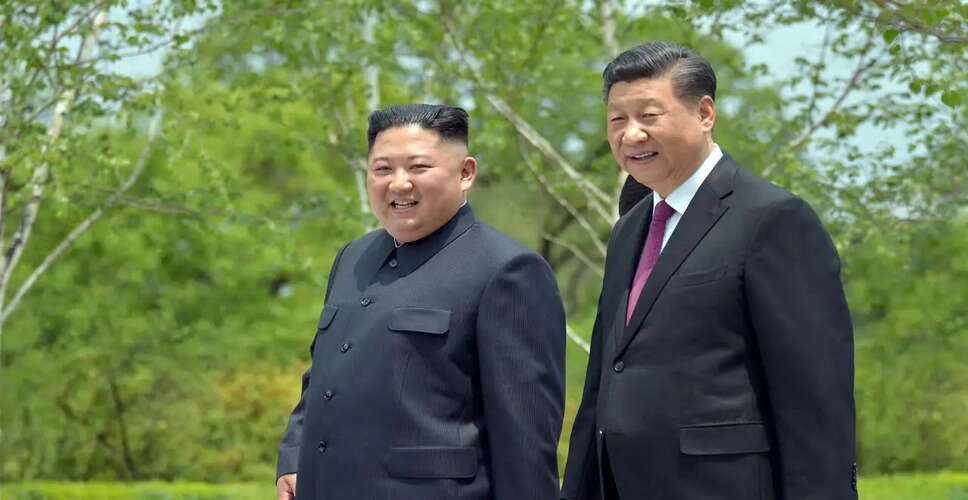

Xi Jinping's Recent Summit with Kim Jong Un
This week, state-run media from China and North Korea extensively covered Xi Jinping's meeting with Kim Jong Un, yet notably omitted any reference to a critical issue for the United States: North Korea's unwavering pursuit of nuclear weapons that pose a threat to the U.S. and its Asian allies. This omission speaks volumes, suggesting a shift in the narrative.
Prior to the collapse of disarmament negotiations in 2019, Washington and Beijing collaborated for years to persuade North Korea to relinquish its nuclear ambitions in exchange for essential aid and political recognition. Beijing had consistently advocated for 'denuclearization'—a term synonymous with nuclear disarmament—leading to hopes in Washington, Seoul, and Tokyo that China would leverage its influence as Pyongyang's diplomatic and economic ally to address the nuclear impasse.
Xi's recent visit to Pyongyang, his first in seven years, may indicate a departure from these hopes and a significant change in his perspective regarding North Korea's nuclear arsenal. From Beijing's viewpoint, Xi's lack of commentary on nuclear arms could reflect an acknowledgment of the advancements in North Korea's nuclear program since Kim Jong Un assumed power in 2011, as well as the diminishing likelihood of diplomatic efforts persuading the North to abandon its weapons, which it views as vital for protection against external threats.
Implications of Xi's Silence for North Korea
During Xi's last visit to North Korea in 2019, he was quoted as stating that China would play a constructive role in the denuclearization of the Korean Peninsula. However, Beijing's primary concern remains stability in North Korea and the surrounding region, as a collapse in Pyongyang could result in a mass influx of refugees across their shared border. Consequently, China has often refrained from directly advocating for the termination of North Korea's nuclear program, as noted by Jiyong Zheng, dean of the Institute of Regional Studies at Tianjin Foreign Studies University.
Instead, China has called for the denuclearization of the entire Korean Peninsula, a phrase that allows it to express a desire for the cessation of U.S. commitments to utilize its nuclear arsenal for South Korea's defense and the deployment of U.S. nuclear-capable bombers in the region. Recently, Beijing has indicated a preference for stabilizing the situation on the peninsula, with denuclearization being a secondary objective, according to Zheng.
For Kim Jong Un, the absence of public criticism or mention of his nuclear capabilities is a significant victory. He has long sought international recognition for North Korea as a nuclear state, which could pave the way for the lifting of U.N. sanctions.
Concerns for Seoul and Washington
When questioned about whether Seoul should temper its expectations regarding Beijing after Xi's apparent avoidance of the nuclear topic in Pyongyang, South Korean Foreign Ministry spokesperson Park Il maintained that China continues to support the goal of nuclear disarmament. Similarly, following last month's summit between U.S. President Donald Trump and Xi, the White House stated that both leaders reaffirmed their shared objective of denuclearizing North Korea. However, China only indicated that the nuclear issue was discussed.
On Sunday, Kim's sister, Kim Yo Jong, dismissed the U.S. interpretation of the Xi-Trump meeting as 'false information.' Last week, Kim Jong Un unveiled a new facility for producing nuclear materials and pledged to enhance nuclear capabilities 'at an exponential rate.' His sister also remarked that any U.S. efforts toward North Korea's denuclearization were an 'anachronistic dream.'
It appears that China may prefer to prevent North Korea and the U.S. from growing too close, as suggested by Park Won Gon, a professor at Ewha Womans University, indicating that Beijing might want to maintain North Korea within its sphere of influence to leverage that relationship with the U.S.
Xi's Implicit Acceptance of North Korea's Nuclear Aspirations
South Korean President Lee Jae Myung informed reporters on Monday that North Korea is producing sufficient nuclear fuel annually for approximately 10 to 20 bombs and is nearing the perfection of its intercontinental ballistic missile technology, which could potentially deliver a nuclear weapon to the U.S. mainland. Kim has emphasized that nuclear arms are integral to North Korea's national identity, enshrining its nuclear status in the constitution and allocating increasing resources toward its maintenance.
Some analysts interpret China's avoidance of the term 'denuclearization' during Xi's recent visit as a clear shift in Beijing's stance, suggesting a tacit acceptance of North Korea's nuclear status. This change could imply that the efforts by the U.S., Japan, and South Korea to deter North Korea will become a more consistent endeavor rather than a temporary measure, according to Seong-Hyon Lee, a senior fellow at the George H.W. Bush Foundation for U.S.-China Relations.
Lee argues that Beijing's silence should not be seen as a mere oversight but as a strategic signal. By implicitly acknowledging North Korea's nuclear status, Beijing reinforces its role as a crucial player in any future negotiations. Nonetheless, China's acceptance of North Korea's military ambitions may have its limits. While Xi's visit indicates a 'strategic embrace of Kim,' it does not equate to a blank check for North Korea, as noted by Leif-Eric Easley, a professor at Ewha Womans University. Beijing seeks stability and respect for its regional aspirations, and North Korea's ongoing military advancements may test the boundaries of what China is willing to tolerate.